Faculty In Focus: How the Director of Computing Programs Is Advancing Innovation and Inclusion
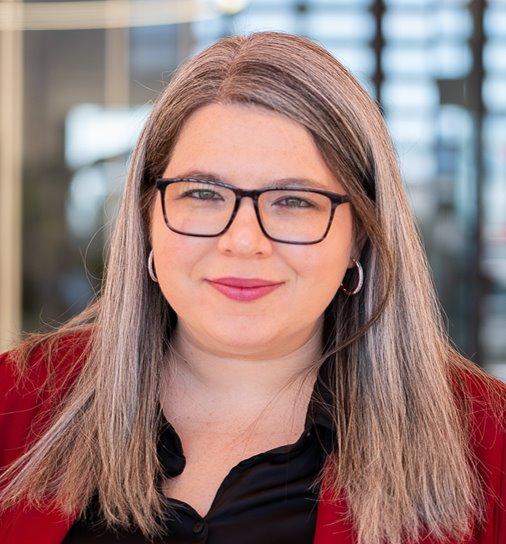
Dr. Gabriela Gongora-Svartzman still remembers looking around one of her undergraduate computer science (CS) classrooms and noticing she was one of only three women there. Later, while working in industry, she found herself in similar situations—the only woman at the table. Those moments didn’t discourage her; they shaped her. They also strengthened Dr. Gongora-Svartzman’s belief that true innovation in computing is only possible through inclusion.
Today, as an Associate Teaching Professor and Director of Computing Programs for Khoury College of Computer Sciences at Northeastern University in Miami, Dr. Gongora-Svartzman channels those experiences into her daily work.
She leads with a philosophy rooted in access, equity, and real-world impact. With this approach, Dr. Gongora-Svartzman shapes forward-looking curricula and fosters a supportive learning environment for future computer scientists.
“Advocating for my students is personal and intertwined with more than just my career; it comes from my lived experience,” says Dr. Gongora-Svartzman. “When you get to these leadership positions, it’s about making sure students have access to the opportunities you had, and that their path isn’t as difficult.”
Building a Career in Computer Science Education with Ethics and Access
Before joining Northeastern University, Dr. Gongora-Svartzman spent more than a decade building a career that combines industry experience, academic research, and student-centred teaching.
Her academic path accelerated during her doctoral studies, when she developed frameworks to assess how communities respond to disruptions and how data could strengthen public systems. Today, Dr. Gongora-Svartzman’s research continues to impact communities through the use of AI and geospatial data (GeoAI) to address climate challenges and develop ethical, community-focused recommendations. Her work led to multiple conference presentations, workshops, and publications.
“I spent most of my research and teaching career with the idea that computing should improve the lives of communities,” says Dr. Gongora-Svartzman. “I wanted to work at an institution where that vision wasn’t an afterthought. So, to see Northeastern University and Khoury College have the same mission is significant. This commitment to diversity, AI for societal impact, and computer science being for everyone is ingrained in everything we do. It aligns with my ethics.”
Alongside her research, Dr. Gongora-Svartzman cultivated a passion for teaching. She taught and supported courses in engineering economics, data analytics, and applied computing at institutions such as Stevens Institute of Technology and Columbia University. Meanwhile, at Carnegie Mellon University, as an Assistant Teaching Professor, she broadened her teaching portfolio to include machine learning, exploratory data analysis, and visualization.
During this time, Dr. Gongora-Svartzman also worked at the intersection of data science, responsible AI, and public policy. Recently, she explored the potential of generative AI tools for creating more inclusive learning environments for students.
“I’m still applying the learnings from that research in my classes,” she says. “For example, before implementing any policy in my classes regarding AI use, I have conversations with my students about it. It all comes down to inclusive learning to prepare students for a new era.”
Preparing Students for the Real World: Insights from a Khoury College Miami Professor
This foundation made her move to Northeastern University’s Miami campus in early 2025 a natural next step. Here, she could translate her research and teaching philosophy into program design.
As Director of Computing Programs, Dr. Gongora-Svartzman ensures that Northeastern Miami computing programs balance technical depth with essential soft skills and an understanding of technology’s broader impact. She’s also focused on maintaining the traditional MS in Computer Science’s high rigor while keeping the MS in Computer Science – Align equally challenging yet accessible for students from non-technical backgrounds.
“The reality is that students need to be more than good at coding,” says Dr. Gongora-Svartzman, who teaches fundamentals of cloud computing and object-oriented design. “They need to be able to architect solutions, explain their reasoning, and understand the consequences of what they build. Our classes are shifting to reflect that big-picture thinking.”
How The City Shapes Northeastern Miami Computing Programs and Mentorship
For Dr. Gongora-Svartzman, the Miami context matters. The city’s unique tech ecosystem, she says, opens doors for experiential learning and industry access. These are elements she sees as essential to preparing students for the future of work. So, beyond championing the university’s co-op program, Dr. Gongora-Svartzman brings industry speakers into her classes, encourages students to join tech groups, and facilitates unique applied opportunities.
“I’ve lived in other cities where it’s challenging to break into the tech scene, but Miami has so much to offer because it’s still emerging,” she says. “That sort of accessibility is a significant advantage for our students. It’s the same for our Khoury College programs in Miami, where we emphasize career development in the classroom through everything from projects with community partners to workshops with guest speakers.”
Her commitment to connecting students with Miami’s tech scene extends beyond the classroom. By staying active in professional associations such as the Institute for Operations Research and the Management Sciences, Dr. Gongora-Svartzman brings fresh ideas into her teaching while embedding Northeastern’s Miami campus into the city’s growing tech community. It’s a visibility that reinforces the importance of representation.
“A lot of people don’t initially see themselves in tech,” she says. “You’d be surprised how often simply showing up, being present in conferences, doing outreach, and being part of these conversations signals to people that they belong here too.”
Seeing students feel represented is only the first step. Within Khoury College at the Miami campus, Dr. Gongora-Svartzman empowers them through personalized mentorship. She makes herself available for conversations about career goals in CS, guides students to explore what drives them, and supports them in building portfolios that reflect their aspirations.
“I feel a lot of responsibility to make sure my students know there is a space for them in computing, whether they are women, minorities, or just new to STEM,” she says.
By: Izabela Shubair